
3(4)-day course, Instructors: Dr. Jürgen Rarey, Dr. Pascal Böwer
planned future dates:
April 27. – 29. 2025 (English, Berlin in-person, European time zone, Rareytec Co., Ltd.)
at Art’otel, Wallstrasse 70-73, Berlin, D-10179
April 30. Thermodynamics in the process simulator Aspen Plus or CHEMCAD depending on booking
flyer, registration (12 out of 12 places available, please inquire, price: see the flyer)
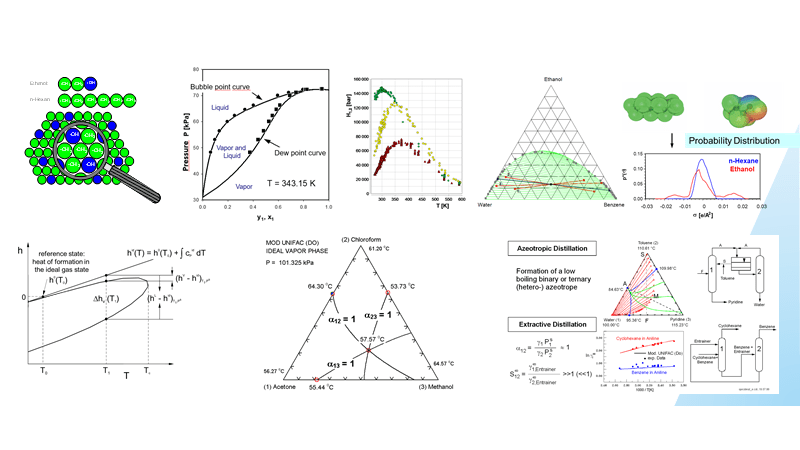
With the ever increasing application of process simulation software tools like Aspen Plus®, ProSimPlus®, Hysys®, CHEMCAD®, Pro/II®, UNISIM® etc., engineers are confronted with the vast complexity of the underlying models and thermodynamic relationships. A sound knowledge and intuitive understanding of these process engineering fundamentals is vital for the development (synthesis), design and optimization of chemical processes. It is generally accepted, that any flaw in the underlying models and parameters usually leads to unrealistic simulation results.
Within this very popular course (more than 1000 participants in the last 20 years) professionals from industry and academics will become familiar with the possibilities and limitations of currently used methods and models. The course focuses on those aspects, which I consider to be of primary importance for the successful modeling of single separation units or whole chemical plants.
Besides the thermodynamic properties of pure components, especially the behavior of multicomponent mixtures will be covered with special attention to phase equilibria, also those of electrolyte systems.
The presentation is organized in four parts:
- Basic pure component and mixture behaviors are presented together with the models that are typically employed in process simulation (equations of state, gE-models, and special correlations for pure component properties like e.g. vapor pressure). This includes discussion of VLE (separation factor, azeotropic behavior, …) and miscibility gaps, gas solubility, solid solubility, … and covers the different ways to obtain especially the binary interaction parameters (BIP).
- Estimation methods for pure component properties (mainly group contribution) and mixture behavior (UNIFAC, mod. UNIFAC, PSRK; …) are vital in cases no experimental data are available. Their basis and range of applicability will be discussed in detail.
- Following the basics of thermodynamics, models and property estimation, various approaches to process engineering problems using modern thermodynamic methods will be presented. These include for example hybrid or pressure swing processes, the selection of suitable entrainers for special separation processes like azeotropic and extractive distillation and extraction. In this part, participants should gain an improved understanding of the various graphical representations of the real behavior of mixtures such as plots on solvent-free basis, contour lines, residual curves incl. boundary lines or surfaces, azeotropic points …).
- Following the first 3 days an optional fourth day offers a workshop on thermophysical properties in the Aspen Plus® simulator and/or the CHEMCAD® simulator.
Practical tutorials are included to deepen the understanding of the various topics. The course is available in the English and German language.
Space is limited and early registration is recommended. The number of participants is limited to 12. In case of online courses, participants should use a second screen on their computer and face into the camera.
Registration fee is changing due to inflation and can be found on the info and registration forms. Early registration is honored by a reduction of € 100. The registration fee includes a copy of the course material and the textbook “Chemical Thermodynamics for Process Simulation”.
Contact
Dr. Jürgen Rarey, Rareytec Co. Ltd. tec@rarey.net
Timetable
| Day 1 | 9.00 | – | 9.30 | Welcome, Introduction – Introduction of lecturer and participants – Course introduction – Technical information |
| 9.30 | – | 12.15 | Pure Component Properties I – PvT-behavior of pure components – Equations of state VdW, SRK, PR, corresponding state principle, critical data | |
| 12.15 | – | 13.15 | Lunch Break | |
| 13.15 | – | 15.15 | Pure Component Properties II – Special equations of state, chemical theory, high precision, PC-SAFT – Residual functions, enthalpy calculation options in a simulator – Vapor pressure, enthalpy of vaporization | |
| 15.15 | – | 15.30 | Coffee Break | |
| 15.30 | – | 16.15 | Pure Component Properties III – Viscosity, thermal conductivity – Molecular structures and property estimation, Joback and new methods | |
| 16.15 | – | 17.30 | Importance of Phase Equilibria Thermodynamic Fundamentals I – Auxiliary functions gi, ji – Activity coefficient models (gE-Models) | |
| 19.00 | Dinner | |||
| Day 2 | 9.00 | – | 10.30 | Thermodynamic Fundamentals II – Calculation of vapor-liquid equilibria – Parameter fitting, consistency tests, … – Activity coefficients at infinite dilution, excess enthalpies – Simultaneous description of phase equilibria and properties (Recommended Values) – Separation factors and azeotropic points as function of temperature |
| 10.30 | – | 10.45 | Coffee Break | |
| 10.45 | – | 11.15 | Thermodynamic Fundamentals III – Equations of state for mixtures, mixing rules | |
| 11.15 | – | 12.15 | Tutorial “Pure Component Properties” and “Phase Equilibria” | |
| 12.15 | – | 13.15 | Lunch Break | |
| 13.15 | – | 14.45 | Special Phase Equilibria I Liquid-liquid equilibria, gas solubilities, solid-liquid equilibria, supercritical extraction, osmotic pressure | |
| 14.45 | – | 15.00 | Coffee Break | |
| 15.00 | – | 15.45 | Special Phase Equilibria II Electrolyte systems | |
| 15.45 | – | 16.45 | Group Contribution Methods for the Estimation of Phase Equilibria – UNIFAC, mod. UNIFAC – Equations of state, mixing rules, modern group-contribution equations of state (e.g. PSRK, VTPR) | |
| 16.45 | – | 17.30 | Application of the Dortmund Data Bank, DDBSP (demo) | |
| Day 3 | 9.00 | – | 11.00 | Different Applications of gE-Models – Residual curves, distillation lines, boundary curves/surfaces Special Separation Processes – Extractive and azeotropic distillation Criteria for Entrainer Selection |
| 11.00 | – | 11.15 | Coffee Break | |
| 11.15 | – | 12.15 | Tutorial “Thermodynamic Properties and Application” | |
| 12.15 | – | 13.15 | Lunch Break | |
| 13.15 | – | 14.45 | Experimental determination of Pure Component and Mixture Data | |
| 14.45 | – | 15.30 | Further Applications of gE-Models and Equations of State – Chemical equilibria in gas and liquid phase, solvent effects on reaction kinetic and equilibrium, pressure effects on vapor phase equilibria – Environmental distribution coefficients – Flash point of flammable liquid mixtures | |
| 15.30 | – | 15.45 | Coffee Break | |
| 15.45 | – | 16.30 | Summary, Discussion |
| Day 4 | 9.00 | – | 10.45 | Physical Properties in Aspen Plus Session I Introduction to Aspen Properties Example Property Method Ideal |
| 10.45 | – | 11.00 | Coffee Break | |
| 11.00 | – | 12.15 | Session II – Routes, Models, Methods – Selecting a Property Method – Thermodynamic Model Parameters | |
| 12.15 | – | 13.15 | Lunch Break | |
| 13.15 | – | 14.45 | Session III – Property Analysis – gE-Model BIPs, Data Regression – Solid Solubility | |
| 14.45 | – | 15.00 | Coffee Break | |
| 15.00 | – | 16.30 | Session IV – Property Estimation – Electrolyte Mixtures | |
or Day 4 | 9.00 | – | 16.30 | Physical Properties in CHEMCAD Components, physical property parameters, analysis Adding a new component, pure component data estimation and regression Thermodynamic wizard, settings Binary analysis Binary interaction parameters (BIPs), sources, regression, estimation Ternary diagrams, residual curve plots Electrolytes, apparent and true components, reactions and data regression Solid-Liquid equilibria Special models (amine, sour water, …) |
| 10.45 | – | 11.00 | Coffee Break | |
| 12.15 | – | 13.15 | Lunch Break | |
| 14.45 | – | 15.00 | Coffee Break |
 __________