
Vapor-Liquid Equilibrium (VLE) Measurement at Rareytec
Most published VLE data come from traditional dynamic recirculation stills or static equilibrium cells.
- Dynamic recirculation stills operate at constant pressure, producing mostly isobaric data that mix temperature and composition effects. They require significant operator experience, large sample volumes, and are prone to issues like foaming or unsteady boiling—especially with viscous or wide-boiling mixtures.
- Static (synthetic) cells (Van Ness method) need thorough degassing and leak-free equipment. They yield P-x data at fixed temperature, from which K-factors are derived via model fitting. However, they provide little information on heavy-component vapor concentrations in wide-boiling systems and become unreliable at higher pressures without specialized sampling and GC analysis.
Looking for a faster, low-sample-volume alternative, we evaluated headspace gas chromatography (HS-GC). Synthetic mixtures are prepared in sealed vials, equilibrated at target temperature with shaking, and the vapor phase (“headspace”) is sampled and analyzed by GC to directly obtain y-compositions—giving xyT data sets.
Commercial HS-GC systems are rarely used for precise VLE because of condensation risks and potential loss of heavy components in sampling lines.
Rareytec’s Optimized HS-GC System
We developed a custom headspace thermostat that:
- Liquid-thermostats the vial bottoms while superheating the upper section with air to eliminate condensation.
- Uses mixture-specific septa (including gold-plated aluminum and stainless steel) to prevent absorption or leakage.
- Employs a superheated syringe for sampling.
Liquid composition is verified before and after each run in cooled vials—close to the known synthetic total composition. This serves as:
- Stability check (detects leakage or degradation).
- Built-in calibration points for GC area-to-mass ratios.
Vials contain PTFE static mixer baffles and are shaken during equilibration. Each of 12 vials is analyzed three times in a single automated GC run (36 injections in 30–60 min). Multiple isotherms for one mixture are typically completed in 1–2 days.
This approach delivers rapid, reliable xyT data with minimal sample quantities and high reproducibility.
We gratefully acknowledge the generous support of Aj. Wiroon Tanthapanichakoon (Charles), CEO of Global R&D, who provided the gas chromatograph, gases, and engineering assistance, and Prof. Panarat Rattanaphanee of Suranaree University of Technology.
We performed a number of test measurements, that will be published in the scientific literature.
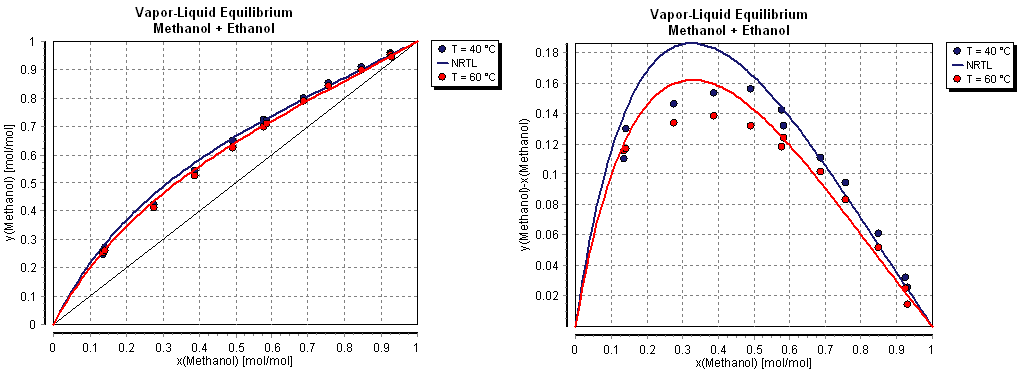
Methanol – Ethanol – simple nearly ideal mixture
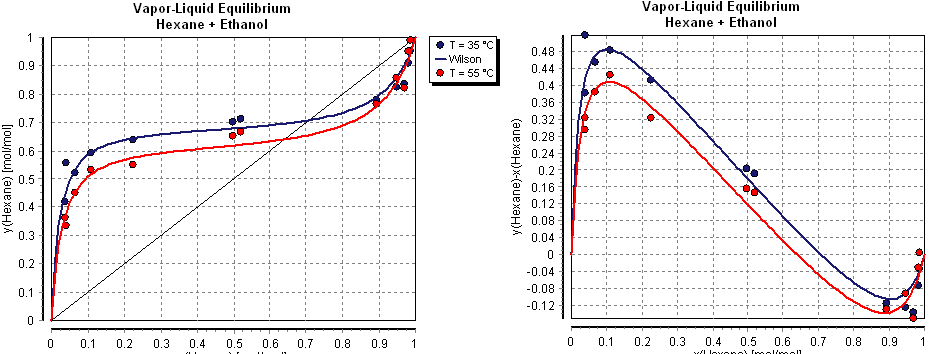
Hexane – Ethanol – non-ideal mixture where one component is an isomer-cut
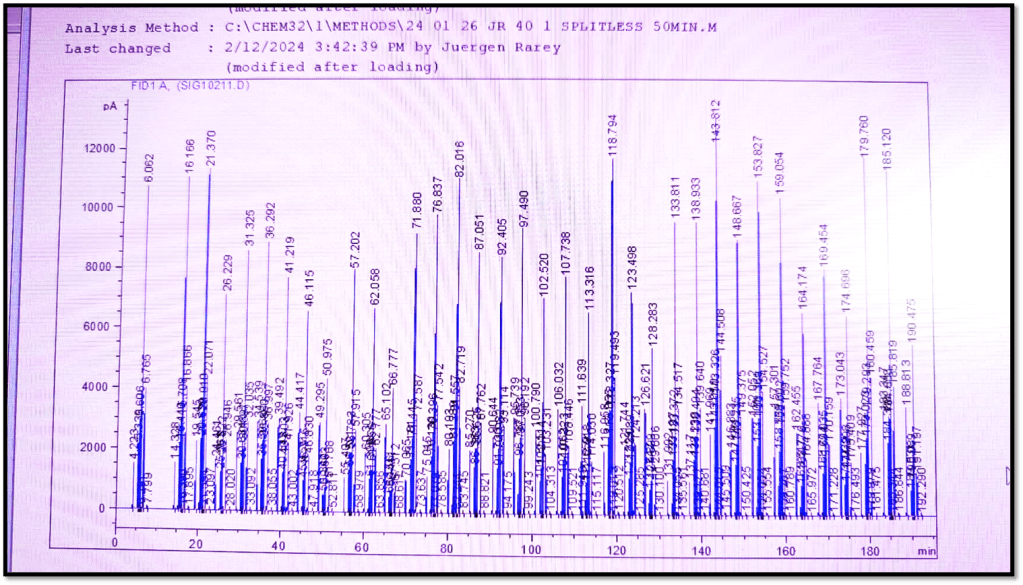
In all cases, samples are analyzed in a single GC run to save time. Each of the 12 sample is injected 3 times. Any trend in the 3 measurements would point to possible non-equilibrium state in the cell. Technical hexane is a mixture of 5 different isomers, so in this case the resulting GC contains 216 component peaks:
Methanol – DMF – wide boiling mixture
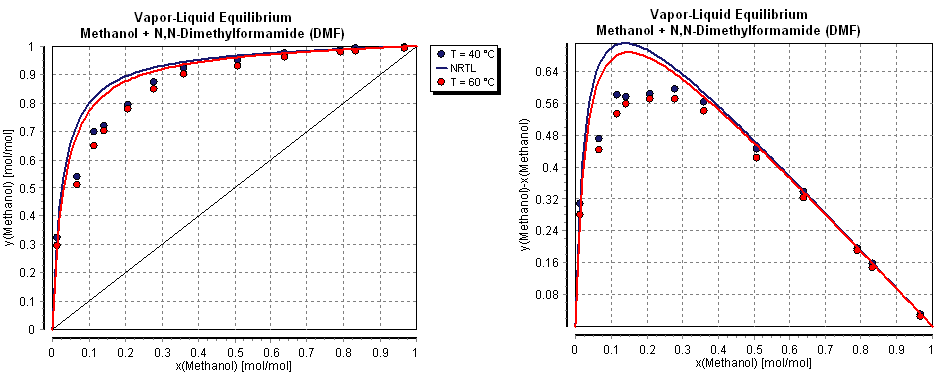
The data generally agree well with the results of common estimation methods except for the case of methanol – DMF, where no literature data are available for the k-factor of DMF in this temperature range.
 __________